

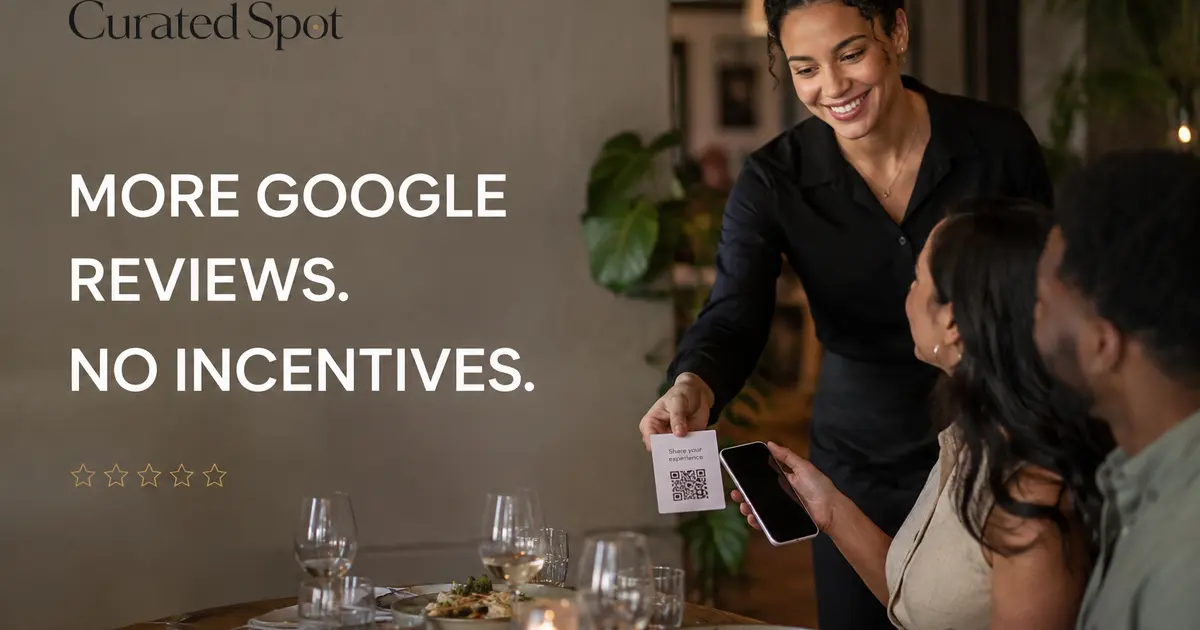
The safest way to get more Google reviews for a restaurant is to ask every genuine guest for honest feedback at a natural moment, make the review link easy to access, and never attach a discount, gift, or other benefit to the request. Build the request into normal service, respond to feedback, and use recurring themes to improve the guest experience.
This approach follows Google Business Profile guidance, which permits reminders and review links but prohibits incentives for posting, changing, or removing reviews. It also creates a review program your team can run consistently instead of a one-week ratings push.
Why a review system matters more than a review campaign
Restaurant reviews influence how guests compare options in Search and Maps, but volume alone is a weak operating goal. The useful question is whether your restaurant can collect a steady stream of genuine experiences without pressuring guests or creating policy risk.
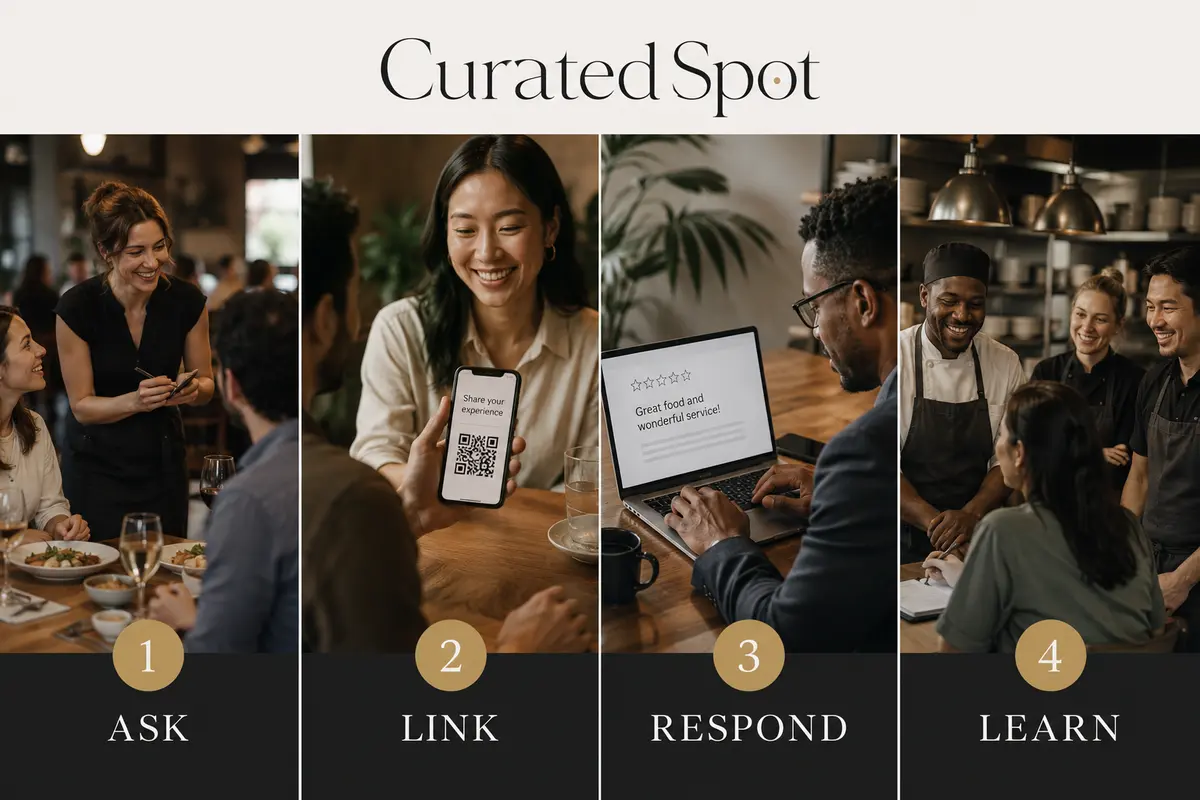
A system has four connected parts: a consistent request, a reliable link, a professional response process, and a learning loop for the venue team. If one part is missing, the program becomes fragile. A QR code without staff training is ignored. A large review count without thoughtful replies can feel impersonal. A dashboard without service changes becomes reporting theatre.
Curated Spot treats reviews as one part of a broader local-discovery signal. Explore the reviews and reputation hub and the review acquisition category for related guidance.
Start with a compliant baseline
Google says reviews must reflect a genuine experience. It classifies payments, discounts, free goods or services, and other benefits offered for reviews as incentivized or biased content. That means a free dessert for a review is not made safe by saying the guest may be honest.
Restaurants should also avoid sentiment filtering. Do not ask, “Did you love everything?” and show the Google link only to guests who say yes. Invite feedback neutrally and use the same path for every eligible customer. The Google Maps policy on incentivized or biased reviews explains why benefits and conflicts can undermine content integrity.
| Practice | Better approach | Risky approach |
|---|---|---|
| Who receives the request | All genuine guests under a consistent rule | Only guests predicted to leave five stars |
| Request language | “Share your honest experience” | “Give us five stars” |
| Reward | No reward connected to the review | Discount, gift, contest entry, or free item |
| Complaint handling | Resolve the issue and let the guest decide | Condition recovery on changing or removing a review |
| Measurement | Requests, completions, response time, themes | Staff bonus based only on star rating |
Choose the right moment to ask
The best moment is after the guest has completed the part of the experience they can fairly review. In a full-service restaurant, that may be after payment. For delivery or a reservation platform, it may be a thank-you message after the order or visit. For a hotel restaurant, the request might follow a post-stay communication rather than interrupt breakfast.
Do not ask while the table is deciding on a tip, while a complaint is unresolved, or before the guest has received the product. The request should feel like an invitation, not a service condition.

Build the restaurant review workflow step by step
1. Create the official Google review link
Open the Business Profile, choose the review-request option, and copy the link or download the QR code. Google documents the process in its guide to creating a review link or QR code. Confirm that the link opens the correct venue and location before distributing it.
2. Select one primary request moment
Pick a moment the team can execute consistently. Start with one channel, such as the payment receipt or a thank-you email, before adding table cards, WhatsApp, or social posts. Multiple simultaneous prompts can annoy regular guests and make attribution impossible.
3. Write neutral request language
A practical script is: “Thank you for visiting. If you have a moment, we would value an honest Google review about your experience.” The words “honest” and “your experience” make the goal clear. Avoid star targets, emotional pressure, and claims that the server needs a high rating.
4. Give staff a short playbook
Train staff on who may be asked, when to ask, and what not to say. Include a response for guests who mention a problem: thank them, alert the manager, and pause the review request. Service recovery comes before acquisition.
5. Configure suppression and frequency rules
If requests are automated, prevent multiple messages for the same visit and set a sensible interval for repeat customers. Keep consent and messaging rules for the channel in view. A good review request should not create a separate spam problem.
6. Respond without sounding automated
Use the reviewer’s actual point when possible. Thank positive reviewers without repeating the same template, and respond to negative feedback calmly. Never expose reservation details, payment information, health information, or other personal data in a public reply.
7. Turn themes into service actions
Group feedback into categories such as welcome, wait time, food temperature, menu clarity, accessibility, and billing. Review the pattern monthly with operations. The purpose is not to “win” every comment; it is to identify repeatable improvements.
Example: a practical four-week rollout
Imagine a neighbourhood restaurant with one location. In week one, the manager confirms the correct Business Profile, generates the official link, and tests it on two devices. In week two, the team adds a discreet QR card at payment and trains servers on one neutral sentence. In week three, the manager begins a daily 15-minute response block. In week four, the team reviews recurring feedback and selects one operational improvement.
This rollout does not promise a particular rating or review count. It creates a repeatable process with clear ownership, making it easier to compare learning over time.
Measure quality without manipulating customers
Measurement should show whether the workflow is functioning and whether the venue is learning. Track the number of eligible visits, requests delivered, completed reviews, average response time, recurring themes, and service changes completed. Compare request channels only when the audience and timing are reasonably similar.
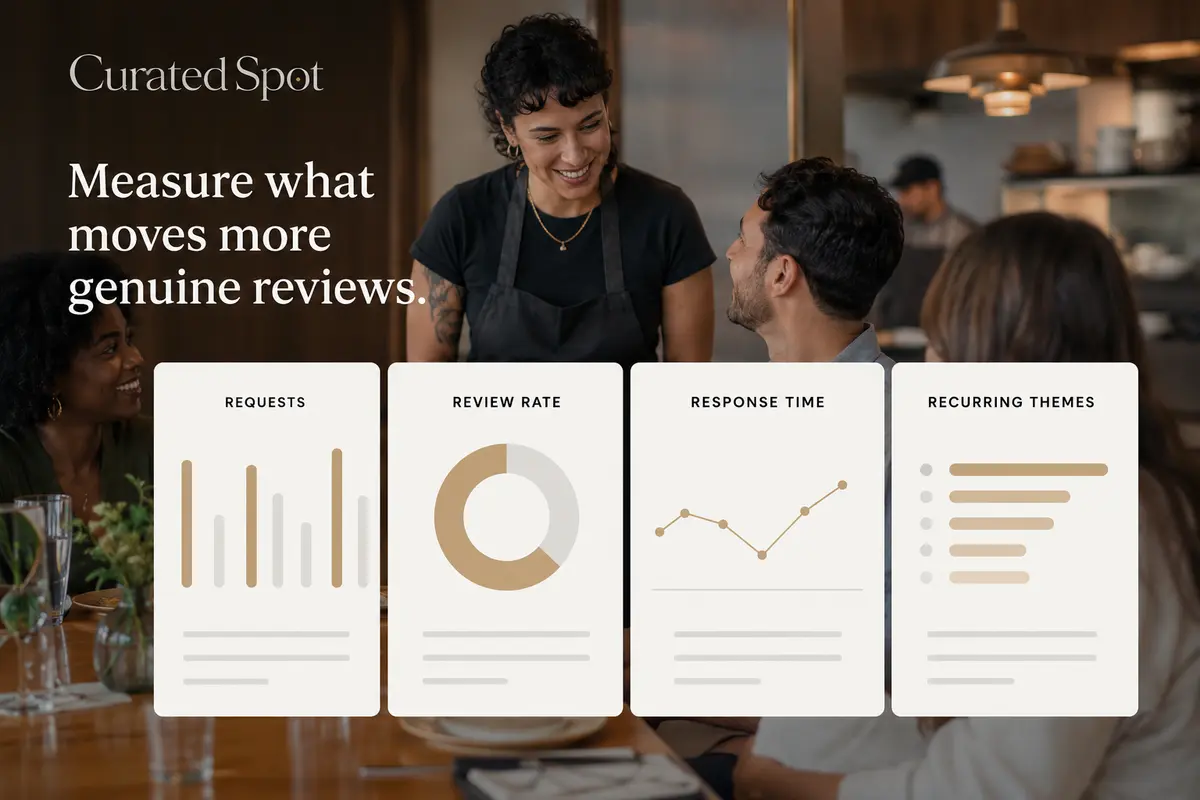
Avoid turning ratings into an individual employee quota. If servers are rewarded only for five-star outcomes, they may pressure customers or ask selectively. Measure execution quality instead: Was the request neutral? Was it offered at the right time? Did the manager respond? Was a recurring issue assigned?
Common restaurant review mistakes
- Offering a free drink, dessert, discount, or prize for a Google review.
- Asking only visibly happy guests while routing unhappy guests to a private form.
- Using “five-star review” language in staff scripts or printed materials.
- Sending several reminders after one visit.
- Leaving the QR code linked to the wrong location.
- Copying the same generic response under every review.
- Arguing publicly or revealing private guest information.
- Buying reviews or using staff, friends, and family to influence the rating.
- Tracking star score without tracking recurring service problems.
- Launching a campaign without a named owner.
Action checklist for restaurant teams
- Verify the correct Google Business Profile and venue location.
- Create and test the official review link and QR code.
- Choose one natural post-experience request moment.
- Write a neutral invitation for honest feedback.
- Train staff on prohibited language and complaint handling.
- Separate loyalty rewards from review requests.
- Prevent duplicate or excessive messages.
- Assign an owner for responses and monthly analysis.
- Track requests, completed reviews, response time, and themes.
- Convert at least one recurring theme into a service action.
- Recheck Google policy and your local legal requirements periodically.
How Curated Spot fits into the discovery journey
Google reviews are one part of how people evaluate a venue. Category pages, local guides, verified venue information, and transparent ranking methodology can support a richer discovery journey. Check how your venue appears in relevant Curated Spot rankings, and review how Curated Spot works before planning the next visibility step.
Frequently asked questions
Can a restaurant ask every guest for a Google review?
Yes. A restaurant may remind genuine customers to share an honest experience. Use the same neutral invitation for all eligible guests rather than asking only people who appear satisfied.
Are discounts allowed in exchange for Google reviews?
No. Google states that free or discounted goods, services, or other benefits offered in exchange for posting, changing, or removing reviews are prohibited. Keep loyalty rewards and review requests completely separate.
What is review gating?
Review gating means filtering customers by sentiment and directing only happy guests to a public review page. A safer process gives every genuine customer the same opportunity to leave public feedback.
When should restaurant staff ask for a review?
Ask after the core experience is complete, such as after payment or in a thank-you message. Avoid interrupting the meal or asking while a complaint is still unresolved.
Should servers ask in person?
They can, if the request is brief, optional, and neutral. Train staff to say that honest feedback is welcome, never to ask for five stars or pressure guests.
Can a restaurant use a QR code for reviews?
Yes. Google provides a review link and QR code workflow for Business Profiles. Place the code where guests can choose to use it, and explain that it leads to an honest-review page.
Where should a restaurant place its review QR code?
Useful placements include receipts, thank-you cards, the payment counter, and post-visit messages. Test visibility without turning the dining room into a wall of review prompts.
How often should a restaurant send a review request?
Usually once per completed visit is enough. Suppress duplicate requests, respect opt-outs, and avoid repeated reminders that feel like spam.
Can employees or owners review their own restaurant?
Reviews should reflect genuine, independent customer experiences. Personal or professional conflicts can create biased content and should not be used to influence the public rating.
Should a restaurant reply to every review?
Prioritize a consistent response system rather than a mechanical promise. Reply promptly to questions, complaints, and detailed feedback, and keep every response specific and respectful.
What should a restaurant do with a negative review?
Acknowledge the concern, avoid arguing, protect personal information, and offer an appropriate path to continue the conversation. Do not pay for removal or pressure the reviewer to change the rating.
Can restaurants ask guests to change a review after resolving a problem?
You may explain what was fixed and let the guest decide whether to update their review. Do not condition compensation, service recovery, or future benefits on a change.
How should a restaurant measure review acquisition?
Track requests sent, completed reviews, response time, recurring themes, and changes by location or service period. Do not judge staff only by star ratings because that can encourage pressure or selective asking.
Who should own the review program?
Assign one accountable owner, often the general manager or local marketing lead, while giving front-of-house staff a simple role. Ownership should include link maintenance, response quality, training, and monthly learning.
How long does it take to get more Google reviews?
There is no guaranteed timeline. A steady, policy-compliant request process usually builds a more durable flow than a short campaign because it becomes part of normal service operations.
Sources and editorial note
- Google Business Profile Help: Tips to get more reviews
- Google Business Profile Help: Create a review link or QR code
- Google Maps policy: Incentivized or biased reviews
- FTC: Soliciting and Paying for Online Reviews
Last editorial verification: August 20, 2026. Platform rules and local legal requirements can change. Verify the current policy for each review platform and jurisdiction before launching a program.