


A restaurant marketing strategy for 2026 should connect how people discover a venue, decide it is right for them, visit or book, and return. The practical goal is not to publish more content or chase every channel. It is to create a measurable local demand system: accurate discovery information, a clear reason to choose the restaurant, a low-friction conversion path, and a deliberate return-visit loop.
This guide gives restaurant teams a 90-day operating plan. It is designed for independent venues and small groups that need focus, not a sprawling campaign calendar.
Start with the business outcome, not the channel
“Do more social media” is not a strategy. Neither is “rank higher” or “send a newsletter.” Those are activities. A strategy begins with a specific commercial problem and defines how marketing will change it.
Choose one primary outcome for the next 90 days:
- Increase qualified reservation starts for selected services or time slots.
- Grow direct orders instead of relying only on third-party discovery.
- Build demand for quieter days or an underused daypart.
- Introduce a new menu, event format, or private dining offer.
- Increase repeat visits from guests already acquired.
Then define one audience, one promise, and one next action. A neighbourhood lunch venue may focus on nearby office workers, promise a reliable meal within a limited break, and optimize for menu views or direct reservations. A destination restaurant may focus on weekend planners, promise a memorable occasion, and optimize for advance bookings.
Use the local demand loop
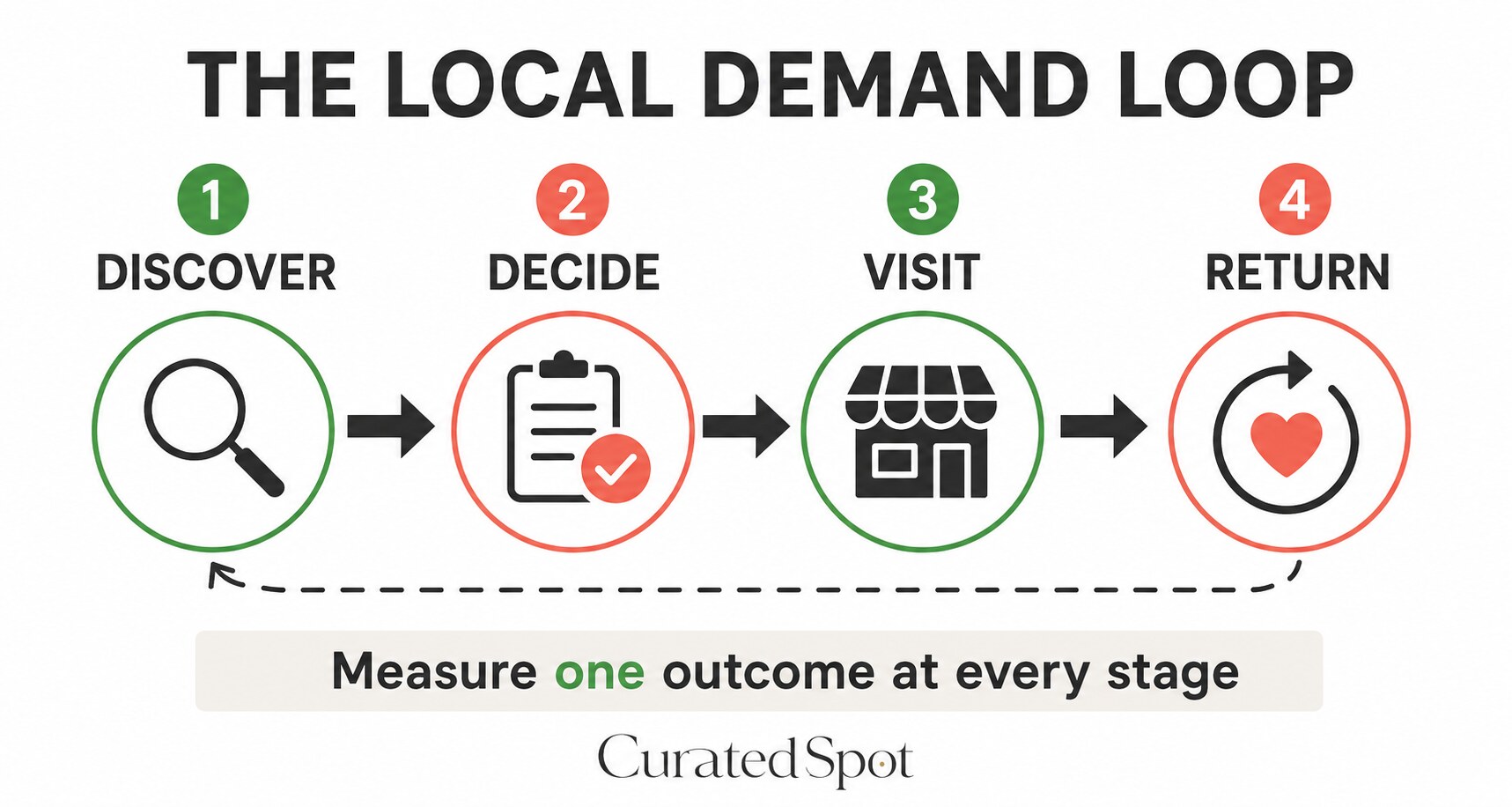
A durable restaurant marketing system has four connected stages:
- Discover: the right people encounter the restaurant in search, maps, rankings, local media, social content, recommendations, or the street itself.
- Decide: the menu, price signal, location, atmosphere, proof, availability, and positioning help them decide whether the venue fits the occasion.
- Visit: the guest can reserve, order, call, navigate, or walk in without avoidable friction.
- Return: the restaurant gives satisfied guests a relevant reason and an easy route to come back.
Marketing breaks when one stage is optimized in isolation. A high-performing Instagram post cannot compensate for an outdated menu. More map visibility does not help if opening hours are wrong. A busy launch weekend does not build a durable customer base if no return mechanism exists.
Build a trustworthy discovery foundation
Before buying attention, make sure every high-intent discovery surface tells the same factual story. Review the restaurant name, category, address, phone number, hours, menu, reservation link, ordering link, accessibility information, service options, and current photography.
Google’s official restaurant Business Profile guidance recommends managing core information, menus, food-ordering and booking options, photos, posts, reviews, and performance metrics. It also identifies searches, menu interactions, and bookings as useful restaurant metrics. See the Google Business Profile guide for restaurants.
That makes profile maintenance an operating responsibility, not a one-time SEO task. Assign an owner and a monthly check. Add special hours before exceptions happen. Keep menu prices and availability aligned with the website. Use the preferred reservation or ordering link intentionally; Google allows businesses to manage local action links for reservations and other transactions, subject to eligibility and policy.
Curated Spot can become part of this discovery layer. Strengthen the paths between the restaurant’s own presence, relevant local discovery pages, and transparent editorial rankings. Explore the Restaurant Marketing hub and learn how Curated Spot works.
Give people a specific reason to choose you
Many restaurant messages are interchangeable: fresh ingredients, friendly service, unforgettable experiences. These claims are too broad to reduce decision uncertainty.
Position the restaurant around a real guest situation. Useful positioning combines:
- Audience: who the restaurant serves especially well.
- Occasion: the moment or need that triggers the visit.
- Evidence: the menu, service model, environment, location, team, or process that proves the promise.
- Action: the easiest appropriate next step.
For example: “A calm weekday lunch near the business district, with a concise seasonal menu and online booking” is more useful than “an elevated dining experience.” It helps shape photography, landing-page copy, search terms, offers, and partnerships without inventing a gimmick.
Create a balanced channel mix
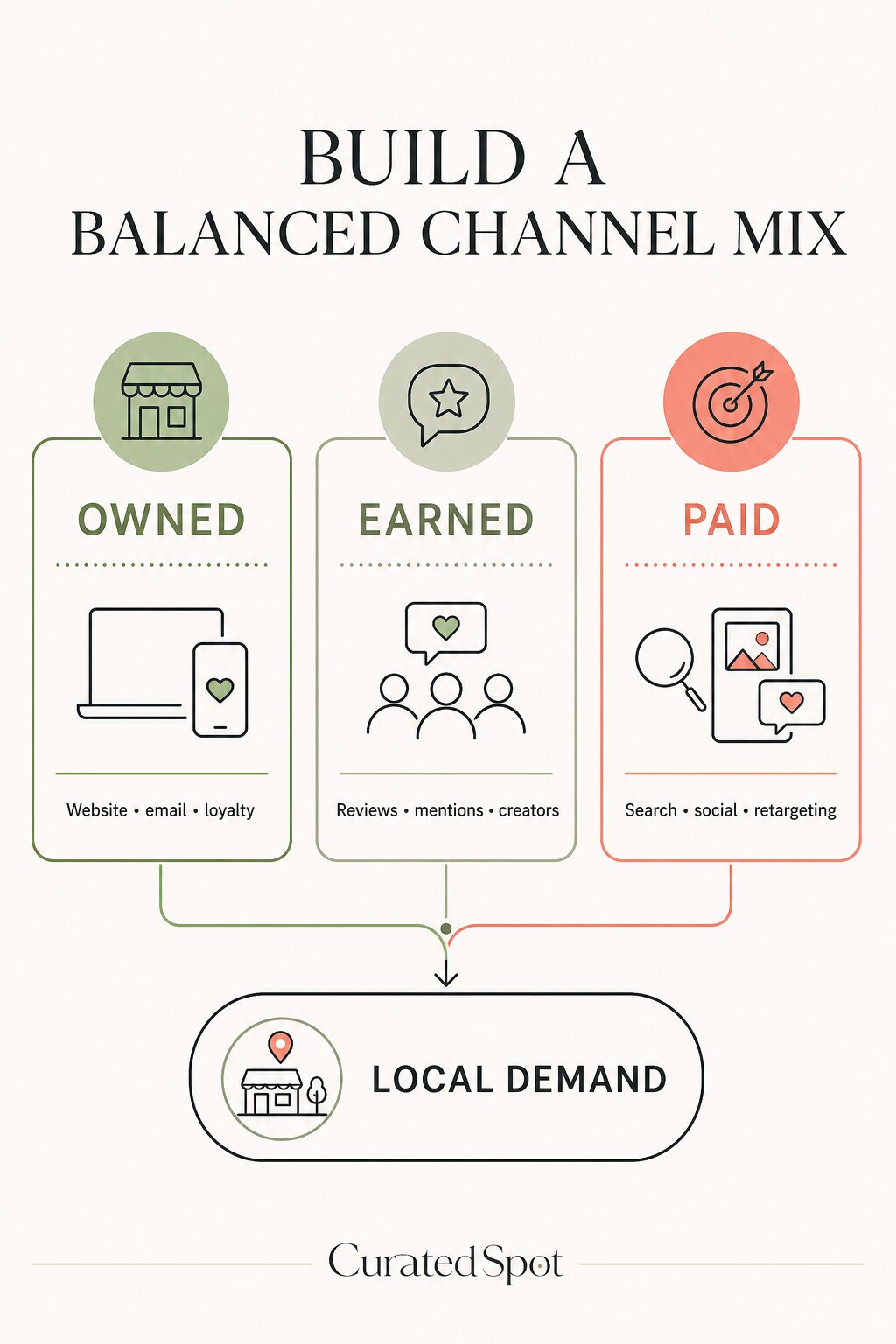
Use three channel layers instead of depending on a single platform.
Owned channels
Your website, menu pages, booking flow, email list, customer database, and loyalty mechanism are assets the restaurant can improve directly. Owned channels should answer decision questions quickly: what is served, how much it costs, when the venue is open, where it is, what the atmosphere is like, and how to act.
Earned channels
Reviews, local recommendations, editorial mentions, creator coverage, partner referrals, and guest sharing transfer trust. Earned attention works best when the underlying experience is genuinely useful and the restaurant makes accurate information and quality media easy to access. Do not buy undisclosed praise or pressure guests for positive sentiment.
Paid channels
Paid search and social can accelerate a clear offer or help reach a defined local audience. They should not be used to hide a weak booking experience. Start with a small, traceable campaign tied to one landing page and one conversion event. Separate brand protection, high-intent acquisition, event promotion, and retargeting so results remain interpretable.
Plan content around decisions, not posting frequency
Restaurant content should help a person imagine, evaluate, or act. Build a reusable evidence library rather than inventing a new concept every day:
- Current menu and signature dish photography with accurate captions.
- Short explanations of ingredients, sourcing, preparation, or service rituals.
- Clear views of the room, terrace, entrance, seating, and relevant accessibility details.
- Occasion-led stories: quick lunch, date night, family gathering, private event, late service.
- Team expertise and behind-the-scenes process where it adds understanding.
- Guest questions answered directly, without turning every answer into a promotion.
Google Business Profile posts can share updates, offers, and events in Search and Maps, but availability and presentation can vary. Follow the current official Business Profile posts guidance and keep important information on the restaurant’s own site as well.
A practical 90-day restaurant marketing plan
Days 1-30: fix the decision path
- Choose the primary commercial outcome, audience, occasion, and action.
- Audit discovery facts across the website, Business Profile, social accounts, directories, and relevant discovery platforms.
- Fix the mobile menu, reservation or ordering path, tracking, and confirmation experience.
- Create a baseline dashboard for discovery, decision, visit, and return metrics.
- Produce a small evidence library of current, accurate photos and short videos.
Days 31-60: launch one focused demand program
- Select one need state, such as weekday lunch or Sunday group dining.
- Create a useful landing page or improve the relevant existing page.
- Publish supporting search, profile, email, and social content with platform-native formats.
- Build one or two relevant local partnerships.
- Run a bounded paid test only if the offer and conversion path are ready.
Days 61-90: improve conversion and retention
- Compare results by audience, message, channel, placement, and daypart.
- Remove activity that creates attention but no useful downstream signal.
- Improve the weakest step in the demand loop.
- Invite opted-in guests back with a relevant reason, not generic frequency.
- Document the winning process so the team can repeat it.
Measure the system without drowning in dashboards
Use a small measurement set tied to the four stages:
| Stage | Useful signals | Decision it supports |
|---|---|---|
| Discover | Qualified search visibility, profile views, ranking-page clicks, reach in the target area | Are the right people finding the restaurant? |
| Decide | Menu views, key-page engagement, photo interactions, calls, availability checks | Does the information reduce uncertainty? |
| Visit | Reservation starts and completions, orders, directions, tracked calls | Can intent become an action? |
| Return | Repeat reservations, opted-in subscriber activity, loyalty participation, returning direct traffic | Is acquired demand compounding? |
Use UTM parameters for distributed links, consistent event definitions for conversion steps, and regular spot checks. A metric is useful when it changes a decision. It is not useful because a platform makes it easy to report.
Common restaurant marketing mistakes
- Trying every channel without choosing an audience or outcome.
- Promoting an outdated menu, price, schedule, or reservation path.
- Using identical copy and creative across platforms.
- Measuring reach while ignoring bookings, orders, or repeat visits.
- Discounting by default instead of clarifying the value and occasion.
- Depending on one platform and neglecting owned customer relationships.
- Manufacturing reviews, endorsements, scarcity, or performance claims.
- Publishing at high frequency while the guest decision path remains weak.
Action checklist
- One 90-day business outcome selected.
- One priority audience and occasion defined.
- Discovery facts and links verified.
- Website menu and conversion flow checked on mobile.
- Owned, earned, and paid roles documented.
- Content evidence library created.
- UTM and conversion tracking tested.
- Weekly operating review scheduled.
Ready to connect your restaurant to more relevant local discovery? Explore Curated Spot’s Hospitality Marketing & Growth resources or submit a spot for consideration.
Frequently asked questions
1. What is a restaurant marketing strategy?
It is a coordinated plan that defines the audience, commercial outcome, positioning, channels, conversion path, and measurement system used to create and retain restaurant demand.
2. What should a restaurant market first?
Start with accurate discovery information and a clear conversion path. Promotion is inefficient when hours, menus, booking links, or core positioning are unclear.
3. How long should a restaurant marketing plan run?
A 90-day plan is long enough to execute and learn while remaining short enough to change. Keep the long-term positioning stable and review tactics weekly.
4. Which restaurant marketing channel is best?
No channel is universally best. Choose channels based on the target guest, occasion, local market, conversion path, and evidence from measured tests.
5. Does a restaurant need social media?
Social media can support discovery and trust, but it should not replace an accurate website, menu, Business Profile, booking path, or customer retention system.
6. How much should a restaurant post?
Post only as often as the team can publish useful, accurate, platform-native content. Consistency matters, but quality and operational accuracy matter more than volume.
7. What content works for restaurants?
Content that answers decision questions or provides credible evidence works best: menus, dishes, atmosphere, occasions, processes, people, location details, and guest guidance.
8. How can restaurants improve local discovery?
Keep business information consistent, maintain useful local profiles, publish crawlable website content, earn legitimate reviews and mentions, and connect to relevant local discovery resources.
9. Should restaurants use paid ads?
Paid ads can accelerate a clear offer with a working conversion path. Begin with a bounded budget, one objective, one landing page, and tested tracking.
10. How should restaurants measure marketing?
Measure the complete demand loop: discovery, decision signals, completed actions, and return behaviour. Tie each metric to a decision the team can make.
11. Are discounts a marketing strategy?
No. A discount is a tactic. Use it only when the economics, audience, timing, and intended behaviour are clear, and avoid training guests to wait for offers.
12. How can a restaurant get more repeat visits?
Deliver a consistent experience, collect permission for direct communication, segment messages by relevance, and give guests a credible reason to return.
13. What is the role of reviews in restaurant marketing?
Reviews provide guest perspective and decision evidence. Ask neutrally, respond helpfully, follow platform policies, and never manufacture or incentivize positive sentiment improperly.
14. How often should restaurant information be audited?
Run a focused check monthly and before holidays, menu changes, events, closures, or major campaigns. Correct urgent factual errors immediately.
15. What is the biggest restaurant marketing mistake?
The biggest mistake is optimizing activity instead of the guest journey. More posts or clicks do not help when discovery facts, positioning, conversion, or retention are broken.