



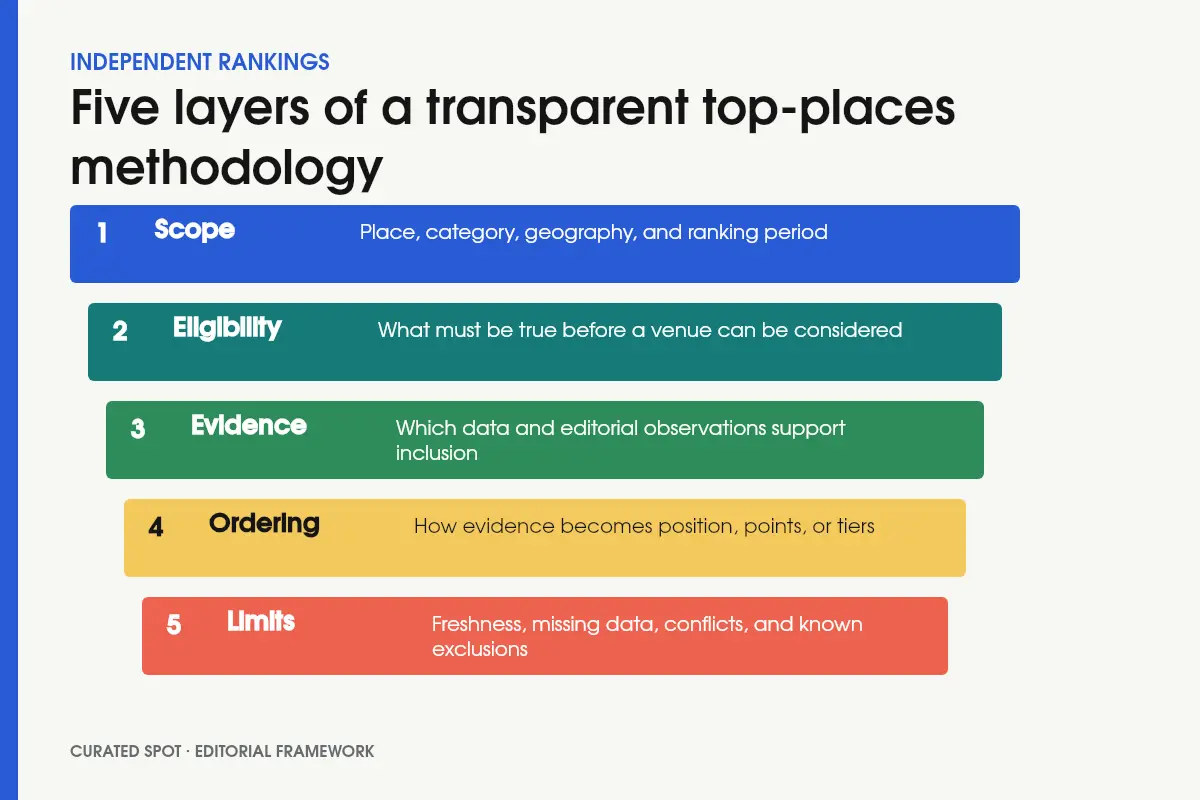
A credible top-places list methodology explains five things before asking anyone to trust a position: the scope of the list, the eligibility rules, the evidence considered, the ordering logic, and the known limitations. It also records when the data was checked and keeps editorial ranking decisions separate from sponsorship or paid visibility.
Without those elements, a numbered list can look precise while hiding major judgment calls. A coffee ranking may cover one city or an entire county. It may reflect one month or a rolling year. It may include only currently verified venues or every listing in a database. The methodology is what turns those choices into an inspectable editorial product.
Define the list before calculating a rank
Start with a plain-language definition. Name the place category, geography, period, and intended use. “Top coffee spots in Timișoara for August 2026” is materially different from “best cafes in Romania.” The first can be bounded by a city, an offering, and a time window. The second combines multiple markets, formats, and use cases into a claim that may be impossible to defend.
The title, page introduction, filters, and methodology should use the same scope. If a user changes the ranking period from month to season or year, the interface should make that change visible. If a list covers only eligible records with complete data, say so. Precision begins with the boundary, not the score.
Set eligibility rules that match the promise
Eligibility determines which venues can enter the comparison. Useful rules may include current operating status, verified location, relevant category or offering, sufficient evidence, and a defined freshness threshold. The rule should not change quietly for a preferred venue.
Document exclusions as carefully as inclusions. A venue may be temporarily closed, duplicated, outside the geography, missing the required category, or too incomplete to compare. An exclusion does not necessarily mean poor quality. It may simply mean the record does not satisfy the current list’s evidence standard.
Separate evidence from opinion
A local ranking can combine factual data and editorial judgment, but readers should be able to tell which is which. Addresses, opening status, category, published menu, accessibility information, and a documented ranking period are factual inputs. Atmosphere, suitability for an occasion, and editorial significance require judgment supported by observation or evidence.
Do not imply that a conceptual label is measured data. “Good for a quick coffee” may be a curated use-case assessment. It is not a scientific measurement unless the method actually collected and defined the relevant data. Likewise, a venue’s position inside one system is not proof that it is the universal best choice for every diner.
Explain how ordering works
Ordering can use points, tiers, editorial sequence, or a hybrid. Whatever the mechanism, identify the inputs and describe how they affect position. Readers do not always need a full software implementation, but they do need enough information to understand what a higher position means.
| Methodology layer | Question to answer | Evidence to publish |
|---|---|---|
| Scope | What list is this? | Category, geography, period, audience |
| Eligibility | Who can be considered? | Status, location, category, completeness rules |
| Evidence | What supports inclusion? | Data sources, editorial checks, observation date |
| Ordering | What changes position? | Points, tiers, criteria, tie treatment |
| Freshness | When was it checked? | Collection, verification, publication, next review |
| Limitations | What can the rank not prove? | Missing data, exclusions, uncertainty, scope limits |
Define ties too. If two venues have the same points, explain whether they share a position, use a secondary criterion, or appear in a stable editorial order. Avoid pretending a tiny or arbitrary difference creates meaningful superiority.
Treat freshness as part of the result
Local information changes quickly. Venues close, relocate, change hours, revise menus, add services, or move between categories. A ranking should show the period it represents and the last meaningful update. The more operationally volatile the input, the shorter the review interval should be.
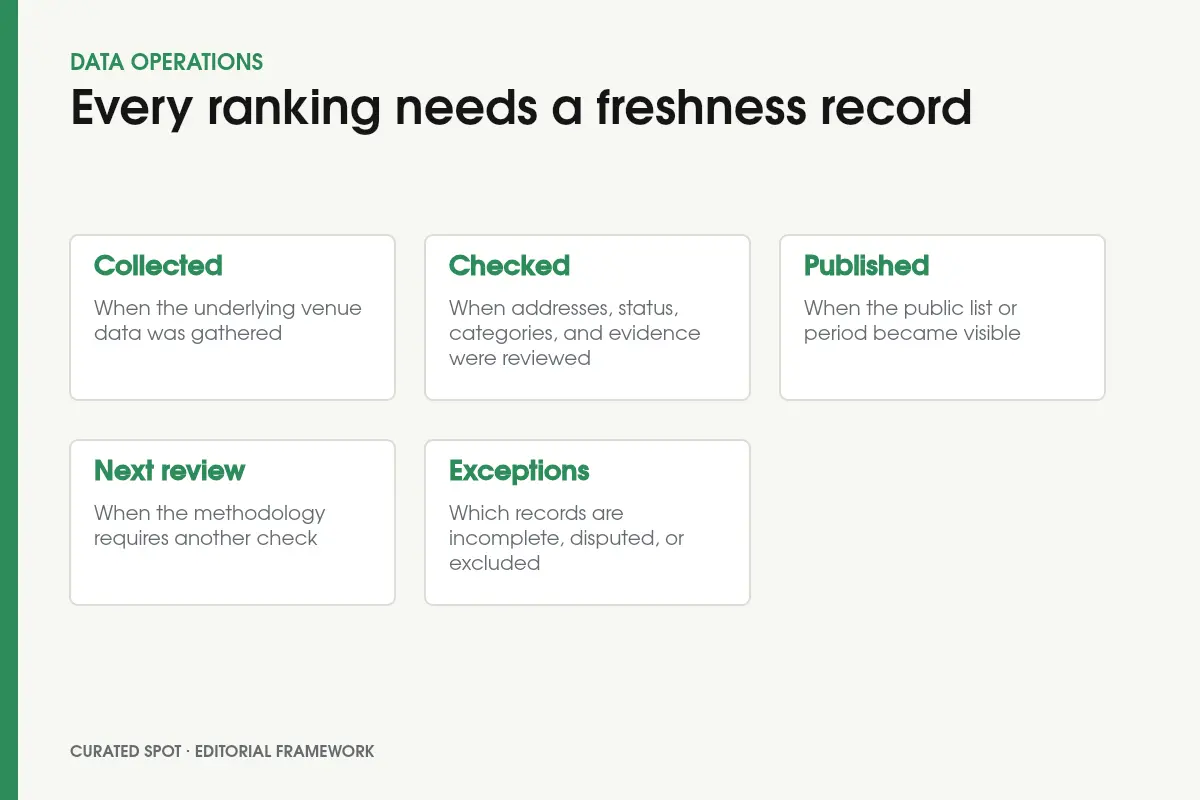
Freshness is not one timestamp. Record when data was collected, when evidence was checked, when the list was published, when it should be reviewed again, and which records have exceptions. That audit trail makes corrections easier and prevents an old list from presenting itself as current by changing only the page footer.
Publish limitations where people can see them
Limitations are not legal padding. They tell the reader how to use the list. Common limitations include incomplete venue data, delayed updates, categories that overlap, seasonal availability, lack of first-hand observation for every record, and evidence that cannot be independently verified.
- A ranking position describes the current system, not an objective truth about every guest’s preference.
- A review rating and an editorial ranking are different signals.
- Points are meaningful only with the definitions and period that produced them.
- Missing or stale data can affect eligibility and position.
- A venue can be excellent for one occasion and unsuitable for another.
- Commercial relationships must not be hidden inside editorial ordering.
Keep editorial ranking independent from sponsorship
Google’s Top Places List documentation says eligible lists must be curated by the content provider, genuine, independent, and not sponsored. It also warns against templated lists built only from data or automated metrics. The product implication is clear: ranking methodology needs human editorial responsibility, and sponsorship cannot buy a position.
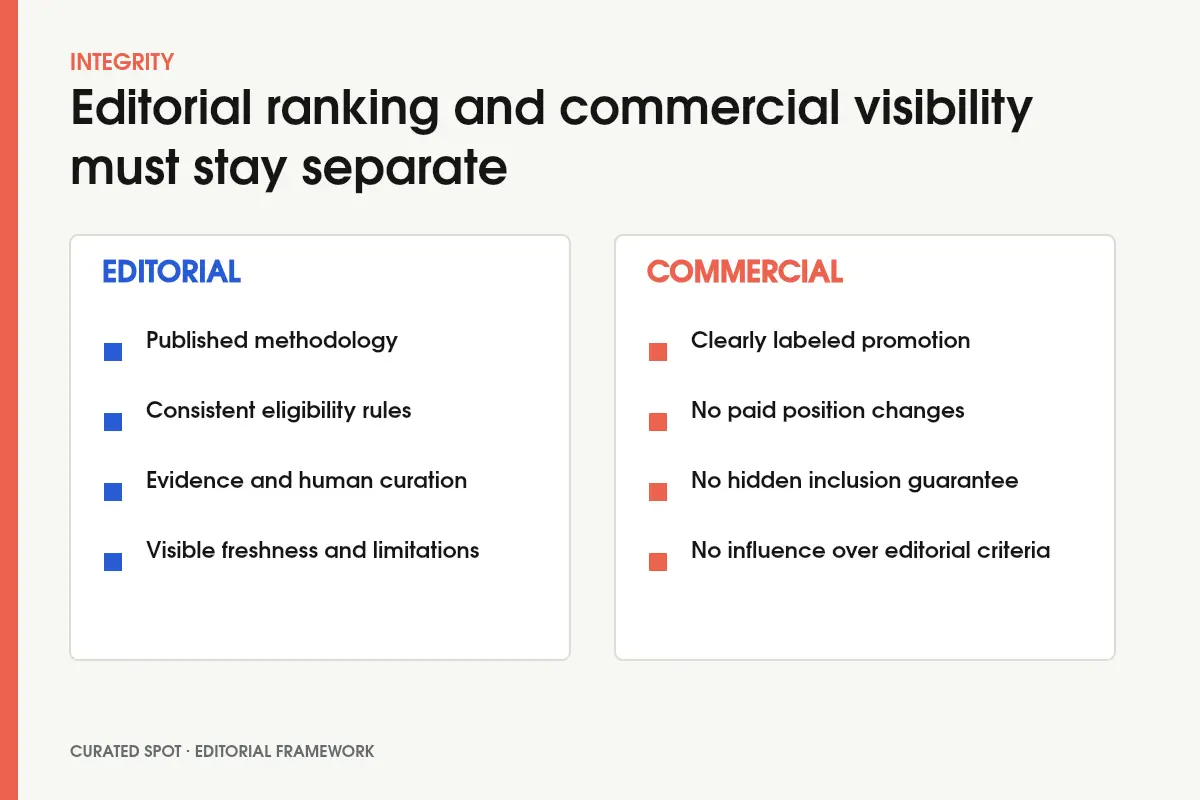
A publisher can sell clearly labeled advertising or commercial visibility without selling editorial rank. Use separate placements, labels, contracts, data paths, and decision owners. Never guarantee inclusion or position in an editorial list as a benefit of payment. Publish a correction process that works for every venue, not only commercial partners.
A Curated Spot ranking example
Curated Spot’s public coffee ranking for Timișoara shows the ranking geography, category, current period controls, visible points, update date, and a link to how the ranking works. The page lets readers switch between month, season, and year rather than collapsing those periods into one permanent claim. Each listed Spot links to a venue page where the user can inspect the place in more detail.
That interface still requires ongoing editorial work. Venue status and category data need review. Users need a clear explanation of points and awards. Corrections must be traceable. The methodology is not finished when the ranking page launches; it is an operating system that must remain current and defensible.
Use rankings as a benchmark, not a vanity target
A venue can use a transparent methodology to understand the list’s scope, verify its own data, and identify relevant evidence gaps. It should not chase position by manufacturing reviews, changing category labels inaccurately, or copying a higher-ranked venue without understanding the audience and occasion.
- Read the scope and period before comparing positions.
- Verify the venue’s name, address, status, category, offer, and public evidence.
- Separate correctable data issues from legitimate editorial judgment.
- Use the methodology to improve customer information and operations.
- Document a factual correction request with direct evidence.
- Measure discovery, conversion, and guest fit rather than position alone.
Common methodology mistakes
- Using “best” without defining category, geography, period, or intended use.
- Changing eligibility after seeing which venues would win.
- Combining review ratings, popularity, editorial judgment, and paid promotion without labels.
- Publishing exact points without explaining what they represent.
- Refreshing the timestamp but not the underlying records.
- Ranking closed, duplicate, or out-of-scope locations.
- Using automated text as a substitute for human curation.
- Hiding limitations in a document no reader can find.
- Letting advertisers influence inclusion, ordering, or awards.
- Treating position as a proxy for revenue, conversion, or universal preference.
Frequently asked questions
How should a business interpret top places list methodology?
Read the scope, eligibility, evidence, ordering, period, and limits before interpreting position. The rank describes one defined system, not the universal quality of the business.
What data limitations should a methodology explain?
Explain missing and stale records, excluded venues, category overlap, unverified claims, period boundaries, geographic limits, and where editorial judgment affects the result.
How often should ranking data be refreshed?
Set the interval according to how quickly the inputs change. Operating status, opening details, categories, and seasonal offers may require more frequent checks than stable methodology documentation.
What is the difference between editorial rankings, review ratings, and points?
An editorial ranking reflects the publisher’s stated method and curation. A review rating aggregates customer submissions under a platform’s rules. Points are values produced by a particular ranking system. They should not be treated as interchangeable.
How can a venue use methodology as a benchmark without chasing a vanity metric?
Verify the venue’s public data, understand eligibility, correct factual errors, and improve the guest journey. Track discovery and conversion outcomes instead of treating one position as the business goal.
How does Curated Spot keep ranking methodology transparent and independent?
Curated Spot publishes ranking context and rules, shows period and freshness information, links ranked entries to Spot pages, and separates editorial ranking logic from paid visibility. The system still requires continuous data review and correction handling.
Inspect the ranking, then inspect the place
Explore Curated Spot’s Rankings & Local Data guides, continue with Editorial Integrity resources, inspect live coffee rankings in Timișoara, read how Curated Spot works, or submit a spot.
Sources and scope
- Google Search Central: Top Places List optimization and eligibility
- Curated Spot: how rankings work
- Curated Spot: live coffee ranking for Timișoara
This article explains editorial methodology and does not claim that one ranking can represent every guest preference or business outcome. Editorial verification: August 2026.