



To increase restaurant revenue sustainably, improve the part of the guest and operating journey that is actually constrained: discovery, booking conversion, table capacity, menu contribution, pricing, quieter dayparts, direct sales, or repeat visits. More sales are useful only when the additional business contributes enough to cover variable costs, labor, fixed costs, and cash needs. Start with the numbers behind each service period, then test one lever without damaging the guest experience.
A busy dining room can still produce a weak result. A promotion can lift sales while reducing contribution. A delivery channel can add orders while fees, packaging, discounts, and kitchen congestion absorb the gain. Revenue is the top line; it is not the same as profit, and profit is not the same as cash available today.
Define the result before choosing the tactic
“Increase revenue” is too broad to manage. Translate it into a specific operating outcome. Examples include filling a quiet Tuesday dinner without weakening Friday demand, increasing contribution from the existing menu mix, converting more high-intent website visitors into direct reservations, improving the table mix for common party sizes, or earning a second visit from guests already acquired.
For every proposed lever, state four things in advance:
- Target: the service, location, daypart, customer group, or menu category affected.
- Constraint: the specific reason revenue is limited today.
- Economics: the expected effect on selling price, variable cost, labor, fees, waste, and capacity.
- Guardrail: the guest or operational measure that must not deteriorate.
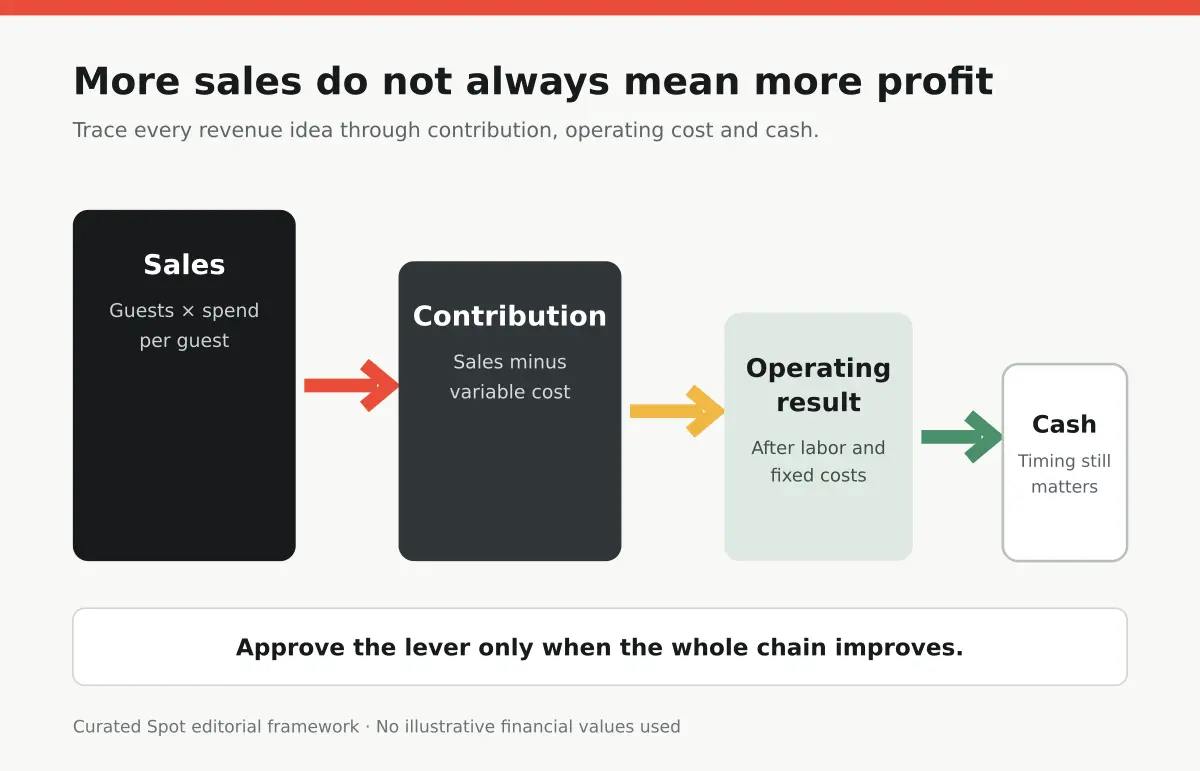
Separate sales, contribution, operating profit, and cash
A restaurant team needs a common language for commercial decisions. Sales revenue is the money earned from food, drinks, service charges, events, delivery, and other trading activity before costs. Contribution asks how much remains after the variable costs associated with those sales. The operating result then accounts for labor and fixed operating costs. Cash adds timing: card settlements, supplier terms, payroll, tax, debt, deposits, and capital spending can make cash movement differ from the accounting result.
The U.S. Small Business Administration explains break-even as the point where total revenue equals total cost. Its basic unit formula is fixed costs divided by price minus variable cost per unit. A multi-item restaurant needs a more detailed model, but the principle remains useful: sales volume alone cannot show whether an item, channel, or service period helps cover fixed costs.
Use actual cost and sales data from the restaurant’s accounting, POS, payroll, purchasing, reservation, and delivery systems. Do not rely on a universal “healthy margin” copied from another market. Rent structure, labor rules, tax, cuisine, service model, opening pattern, and location economics vary materially.
Find the constrained revenue lever
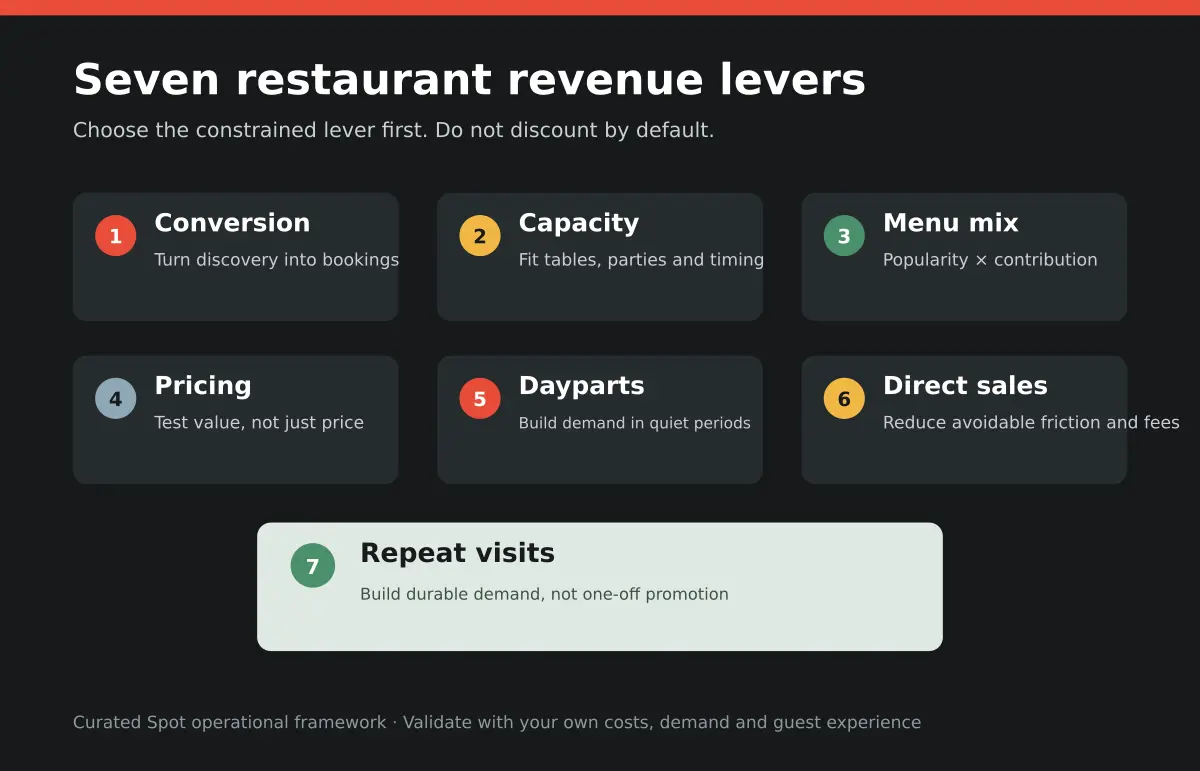
1. Convert more existing demand
Before buying more reach, inspect what happens after a guest discovers the restaurant. Are opening hours, current menus, price signals, dietary information, location, atmosphere, and booking options clear on mobile? Does the reservation flow show availability without unnecessary steps? Are calls answered during the periods when customers decide? Improving a broken decision path can produce more completed actions from demand the restaurant already earned.
2. Use capacity more intelligently
Restaurant capacity is perishable. An empty seat during tonight’s service cannot be stored for next week. Capacity decisions include table mix, party-size fit, reservation spacing, no-show management, turn-time reliability, kitchen throughput, staffing, and the time needed to reset a table without rushing guests.
Cornell researchers Sheryl Kimes and Gary Thompson used restaurant data and simulation to show that table mix can materially affect how many customers a dining room can serve without extending waits. The lesson is not to copy a specific layout; it is to compare the restaurant’s actual party-size demand with the capacity its tables can create.
3. Improve menu contribution, not just food-cost percentage
Review menu items by both popularity and contribution. A low food-cost percentage is not automatically the best item if it adds little absolute contribution, slows the kitchen, creates waste, or displaces a stronger choice. Likewise, a popular item with modest contribution may still support the menu if it drives visits, anchors value, or pairs naturally with profitable additions.
Use the POS menu mix, current recipe costs, preparation time, waste, labor demands, and substitution patterns. Research on menu engineering shows why price changes should consider how guests switch between items, not treat every dish as independent. Test names, descriptions, placement, portion, bundle logic, and service recommendations before removing a familiar item.
4. Price around value and demand
Pricing should reflect the offer, market, experience, cost structure, and demand pattern. A blanket price increase can lift revenue while reducing visits or shifting the mix in an unhelpful direction. A blanket discount can create volume that the restaurant cannot serve profitably.
Test bounded changes where the business case is clear. Compare item-level contribution, units sold, attachment, guest feedback, booking conversion, and service-period demand. Preserve transparent pricing and comply with local consumer, tax, and disclosure rules.
5. Build demand in quieter dayparts
A restaurant with spare Tuesday capacity has a different problem from one that turns away Friday guests. Define a use case for the quieter period: reliable office lunch, early family dinner, late kitchen, tasting event, neighborhood set menu, or group occasion. Promote that occasion to the audience most likely to value it, then track whether it adds business or merely shifts guests from a stronger period.
6. Improve direct revenue paths
Direct reservations, event inquiries, gift cards, pickup, and owned customer relationships may reduce avoidable friction or fees, but only when the restaurant can operate them well. Compare the total cost and service quality of every channel. Third-party platforms can create valuable discovery and demand; the goal is not to remove them blindly, but to understand their role and economics.
7. Earn a relevant second visit
Repeat demand can compound acquisition effort. The restaurant still has to earn it through a consistent experience. With appropriate consent, use direct communication for genuinely relevant reasons to return: a new seasonal menu, a recurring event, a preferred daypart, or a reservation window. Avoid turning every guest into a generic mailing-list target.
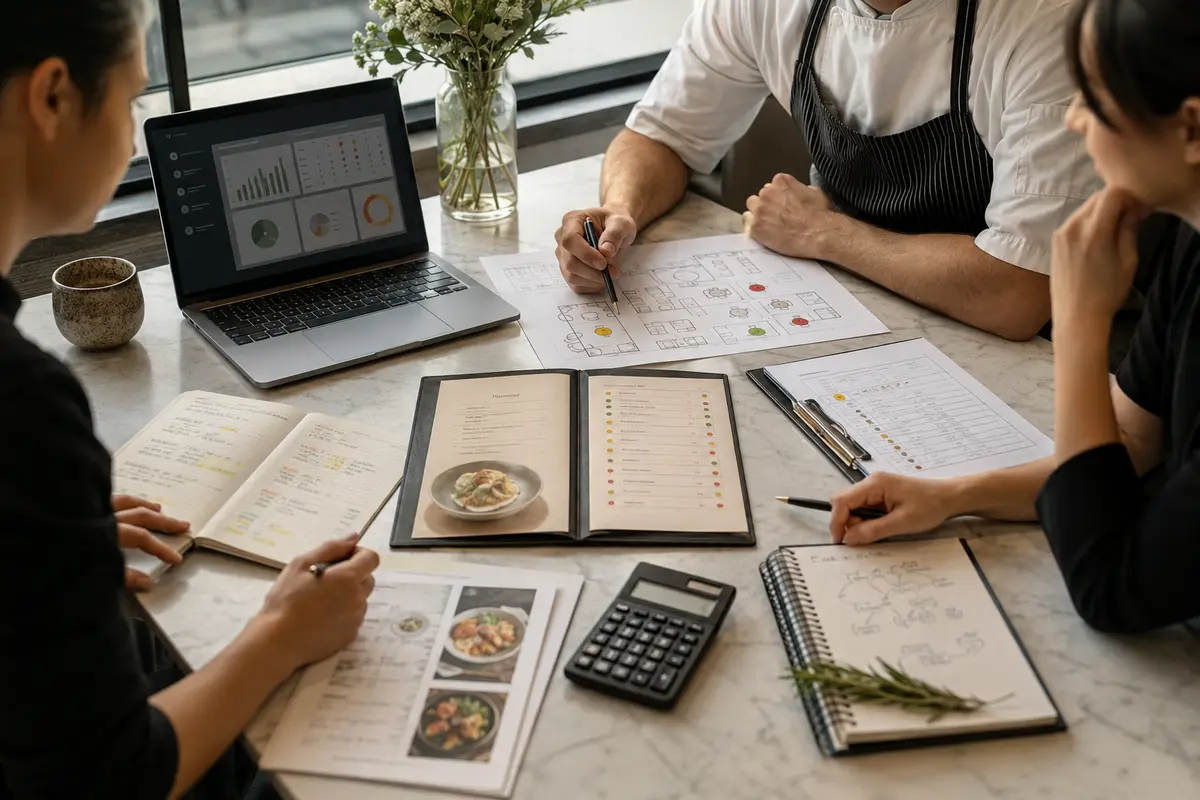
Use a weekly restaurant revenue scorecard
Build the scorecard by location and service period. A single monthly average can hide a strong dinner, weak lunch, profitable dine-in channel, and loss-making delivery promotion. Keep the set small enough to review every week.
| Question | Useful measures | Decision |
|---|---|---|
| Did the right demand arrive? | Qualified discovery visits, reservation searches, calls, directions, event inquiries | Improve audience, occasion, or discovery information |
| Did demand convert? | Booking starts and completions, calls answered, checkout completion, inquiry response | Remove friction or fix availability |
| Was capacity used well? | Seats available, covers, party mix, no-shows, waits, turns, kitchen throughput | Adjust table mix, pacing, policies, or staffing |
| Did the mix contribute? | Item units, price, variable cost, contribution, attachments, waste | Improve menu, pricing, preparation, or recommendation |
| Did the guest experience hold? | Complaints, refunds, review themes, wait accuracy, repeat behavior | Stop a tactic that damages trust or service |
| Did cash improve? | Settlement timing, payroll, suppliers, tax, debt and capital requirements | Protect liquidity and plan commitments |
Run a disciplined revenue experiment
- Choose one location, daypart, menu category, or channel.
- State the constraint and the economic hypothesis.
- Record a clean baseline using comparable periods.
- Change one meaningful lever while holding other decisions as stable as practical.
- Define a duration long enough to observe normal variation.
- Track contribution and guest-experience guardrails, not sales alone.
- Document external factors such as weather, events, closures, and major campaigns.
- Keep, revise, or stop the test based on evidence.
A test can fail commercially and still create useful knowledge. What matters is that the restaurant learns without exposing guests, staff, or cash flow to unnecessary risk.
Common revenue mistakes
- Celebrating gross sales without checking contribution, labor, fees, waste, or cash timing.
- Discounting busy periods that already have constrained capacity.
- Promoting an item without confirming the kitchen can deliver it consistently.
- Using averages that hide weak locations, channels, dayparts, or party sizes.
- Changing price, placement, promotion, and portion at the same time, making the result impossible to interpret.
- Forcing faster turns at the expense of hospitality and repeat visits.
- Rewarding staff only for check size instead of fit, service quality, and guest trust.
- Adding a sales channel without measuring the complete channel economics.
- Treating one strong week as proof of a permanent trend.
- Copying benchmarks from another market instead of building a restaurant-specific model.
Frequently asked questions
What is the fastest way to increase restaurant revenue?
Fix the clearest existing constraint first. That may be booking friction, poor table fit, a weak menu mix, empty capacity in one daypart, or low repeat demand. The fastest useful lever varies by restaurant.
Is restaurant revenue the same as profit?
No. Revenue is the top-line sales amount. Profit accounts for costs, while cash flow also reflects when money is received and paid. A revenue increase can reduce profit or strain cash if its additional costs are too high.
How can a restaurant increase average spend?
Improve menu clarity, item fit, recommendations, pairings, bundles, and premium options that add real guest value. Measure item contribution and satisfaction; do not use pressure or irrelevant upselling.
Should a restaurant raise prices?
Only after reviewing value, demand, costs, competitors, guest response, and the likely change in menu mix. Test bounded changes and follow local pricing, tax, and disclosure requirements.
How can a restaurant fill quiet days?
Create a credible occasion for the spare capacity, target the audience that values it, and measure incremental contribution. Avoid a broad discount that moves existing guests from stronger periods.
Which restaurant revenue metrics matter most?
Track qualified demand, conversion, capacity use, menu contribution, labor, channel cost, guest-experience guardrails, repeat behavior, and cash movement by location and service period.
Improve the next decision, not just the next sales report
Durable restaurant revenue comes from making the operation easier to discover, choose, book, serve, and revisit. Explore Curated Spot’s Revenue & Conversion guides, continue with the Revenue Optimization resources, see how Curated Spot works, or submit a spot for consideration.
Sources and scope
- U.S. Small Business Administration: break-even and business planning guidance
- Kimes and Thompson: Restaurant Revenue Management at Chevys
- Menu engineering re-engineered: pricing, placement, and substitution
This guide provides an operating framework, not accounting, tax, legal, or investment advice. Validate decisions with the restaurant’s current records and qualified local advisers. Editorial verification: August 2026.