


The safest way to ask restaurant customers for reviews is to make one neutral, optional invitation after the experience is complete, give every genuine customer the same clear path, and accept whatever honest feedback they choose to share. The request should never depend on whether a guest appears delighted, and it should never promise a discount, gift, prize entry, or other benefit.
That sounds simple, but the operating detail matters. A rushed server can make an invitation feel like pressure. A marketing automation can become repetitive. A private feedback screen can quietly turn into review gating if only positive respondents are sent to a public platform. This guide turns the request into a small, auditable hospitality process.
Start with the guest, not the rating
A review request is not a tool for manufacturing five-star sentiment. It is a way to reduce friction for customers who already have a genuine experience to describe. Google says Maps contributions must reflect a genuine experience and prohibits incentives offered in exchange for reviews. Google also provides an official review link and QR code that businesses can place on receipts, in thank-you emails, at the end of a chat, or in the venue.
The practical rule is: improve access, not sentiment. Make it easy to find the review form, but do not tell the customer what score to select, do not write the review for them, and do not separate “happy” guests from everyone else before offering the public link.
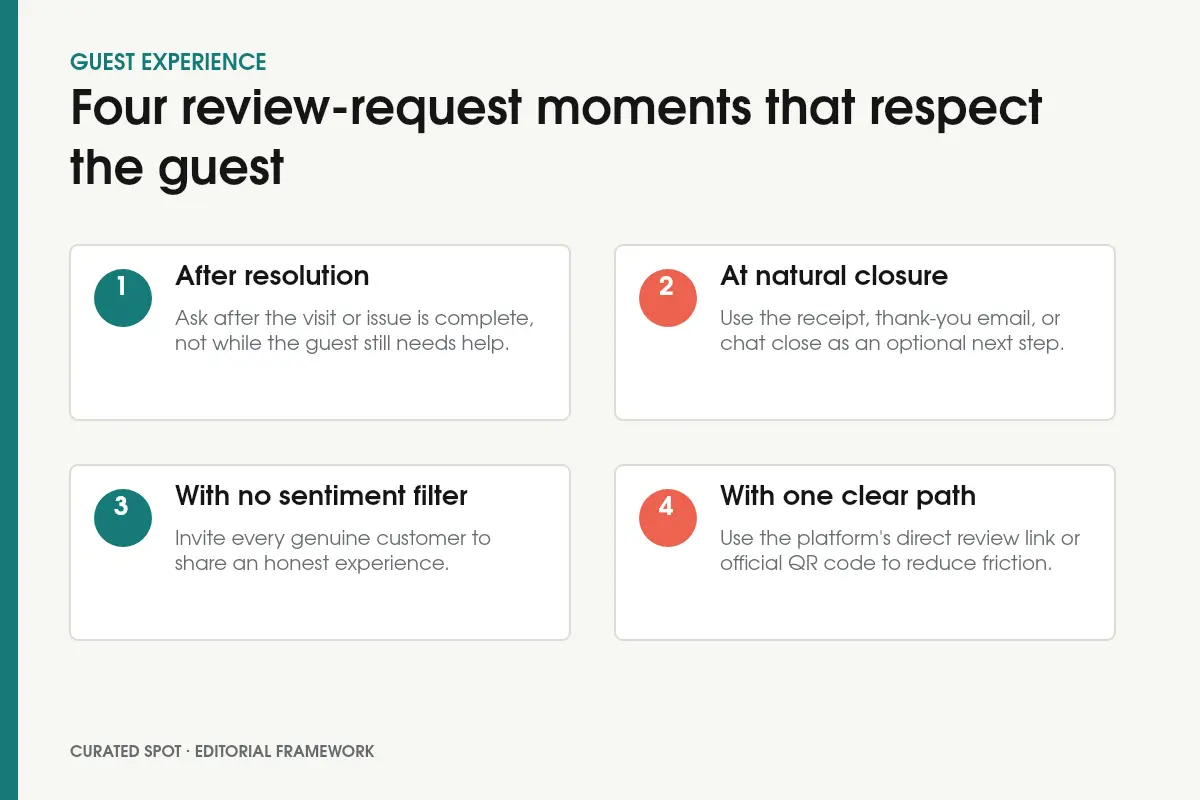
Choose a respectful moment
Timing should follow the service journey. Ask only when the customer no longer needs active help. For dine-in restaurants, that may be on the printed or digital receipt, in a thank-you message after payment, or after a resolved follow-up. For takeaway and delivery, it may be after the expected consumption window. For hotels or event venues, it may be after checkout or after the event organizer has confirmed that the service is complete.
Do not ask while a complaint is unresolved. Do not turn a recovery conversation into a bargain for a better rating. Resolve the issue on its merits, then leave any later review decision to the customer.
Use one neutral script
If you would like to share your experience, this link opens our review page. Honest feedback helps other guests understand what to expect.
This script works because it describes the action, explains the value, and avoids rating language. A cafe can print a shorter version beside its official QR code. A hotel can use the longer version in a post-stay email. A restaurant manager can include it in a response after solving a service issue, as long as the invitation is not conditioned on the customer’s updated sentiment.
Train the team to use the same standard with a broad, consistent set of eligible customers. A policy that says “ask only when the table is very happy” is a sentiment filter, even if the team never uses the phrase “five stars.”
Keep the public request separate from private feedback
Private feedback is useful for service recovery, training, menu development, and operational quality. It should not become a gate that routes positive respondents to a public review page while keeping negative respondents private. Give customers an independent, visible path to the public platform. If you also collect private feedback, explain its purpose and do not make access to the review link depend on the private score.
Assign different outcomes to the two channels. Public reviews help future guests understand the venue. Private feedback helps the team investigate and improve. Neither channel should be used to suppress criticism or pressure a customer to remove a truthful negative review.
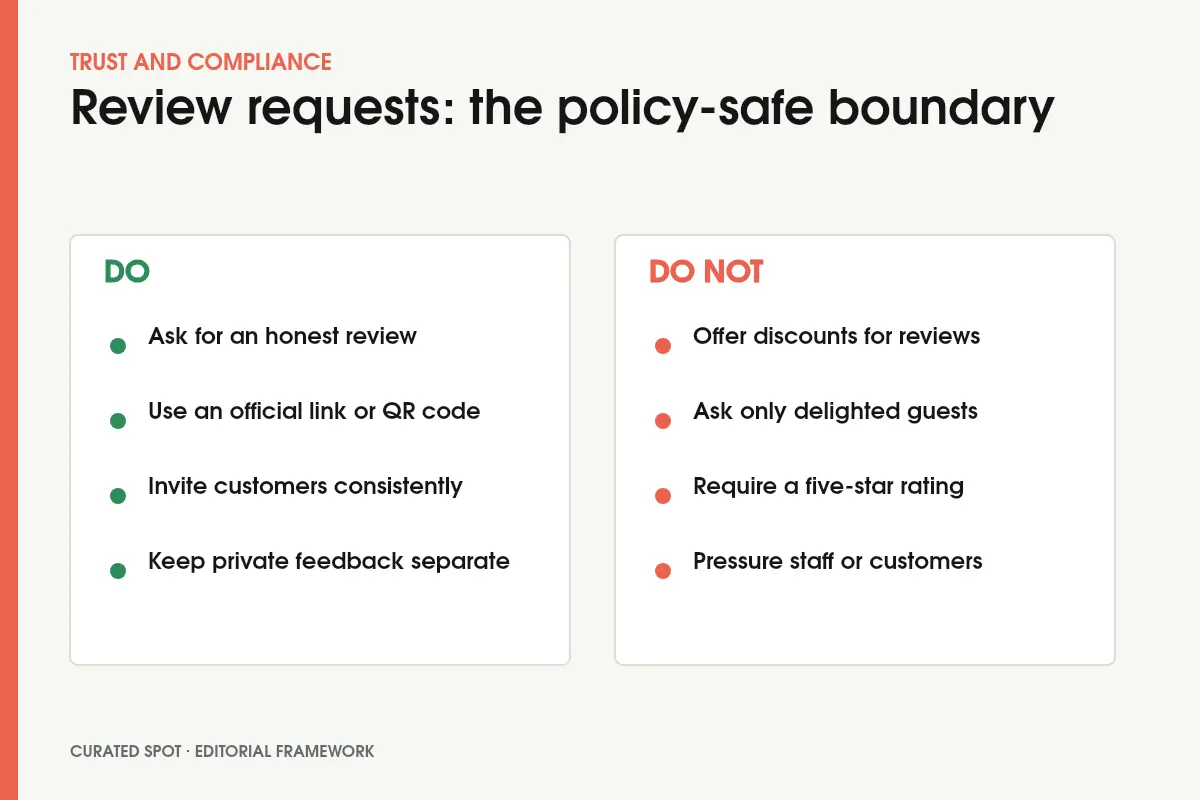
Avoid incentives, pressure, and insider reviews
Google explicitly treats reviews posted because of free or discounted goods or services as fake engagement. That makes the venue rule straightforward: do not exchange a drink, dessert, discount, loyalty reward, prize entry, upgrade, or donation for a Google review. Do not ask for a review revision or removal in exchange for compensation either.
Legal requirements can vary by market and platform. The U.S. Federal Trade Commission’s consumer review rule, for example, prohibits incentives conditioned on a particular sentiment and warns that other incentivized-review practices may still be deceptive without clear disclosure. The safest operating standard for a hospitality brand working across platforms is stricter and easier to train: do not incentivize public reviews at all.
- Do not ask employees, managers, relatives, agencies, or suppliers to pose as ordinary guests.
- Do not provide prewritten copy for customers to paste.
- Do not run an internal contest based on how many five-star reviews a staff member generates.
- Do not ask customers to mention a server by name if that creates pressure or exposes personal information.
- Do not reuse a review on another channel without checking the relevant permission and attribution rules.
Build a seven-step review-request workflow
- Choose the platform and official link. Generate the review link or QR code inside the platform’s business tools.
- Define eligible moments. Use objective events such as completed payment, completed stay, closed support interaction, or resolved complaint.
- Write one neutral invitation. Ask for an honest experience, not a positive rating.
- Set a frequency limit. Avoid asking the same customer repeatedly across receipt, email, SMS, and chat.
- Train the team. Explain the policy boundary and give staff permission not to ask when the timing would interrupt service.
- Monitor delivery and themes. Track whether the process works and what operational issues reviews reveal.
- Audit monthly. Sample messages, receipts, QR placement, staff scripts, and automation rules for consistency.
Measure the system without manipulating customers
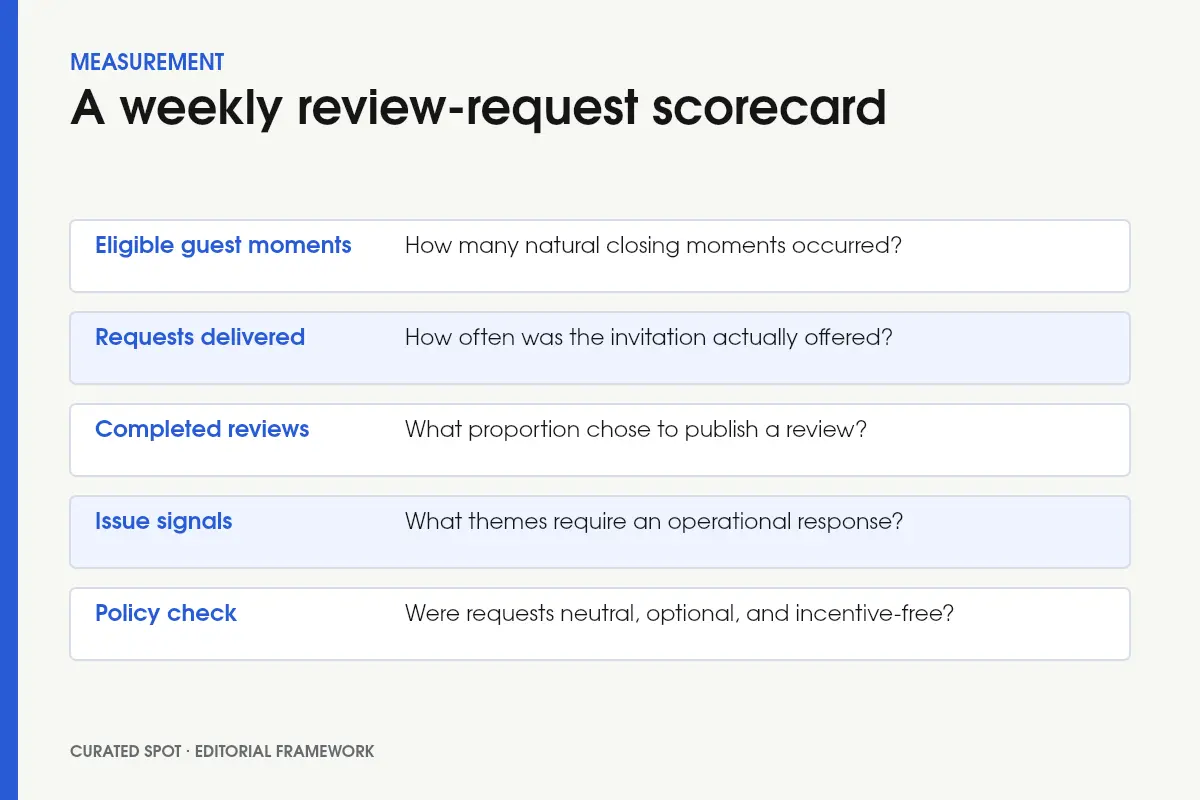
The main performance question is not “How many five-star reviews did we produce?” Measure whether eligible customers received a neutral request, whether the link worked, whether requests became excessive, and whether review themes point to a service issue. Track review volume and completion as diagnostic signals, not as a score staff must force upward.
| Measure | De ce contează | Guardrail |
|---|---|---|
| Eligible guest moments | Shows the real opportunity without sentiment filtering | Define eligibility with objective service events |
| Requests delivered | Reveals training or automation gaps | Set a clear frequency limit |
| Review-form visits | Tests link and QR accessibility | Do not track individual review sentiment back to staff |
| Completed reviews | Shows voluntary customer participation | Do not reward a particular rating |
| Recurring themes | Connects reputation to operations | Investigate facts before acting |
| Policy exceptions | Finds risky scripts or incentives | Correct the process, not the customer |
Greșeli comune
- Putting “Leave us a five-star review” on the bill.
- Offering a free item, discount, prize, or loyalty credit for a public review.
- Sending the public link only after a customer selects a high private-feedback score.
- Asking during service recovery before the problem is resolved.
- Letting every channel send its own request without a frequency limit.
- Turning review count or rating into a staff sales target.
- Responding defensively to a negative review instead of checking the underlying facts.
- Using one script forever without checking platform policy changes.
Întrebări frecvente
What is the safest way to ask customers for restaurant reviews?
Use one neutral, optional invitation after the experience is complete. Offer the same direct path to a broad set of genuine customers and do not use incentives, rating language, or sentiment filters.
Which review practices violate platform policies?
Policies differ, but fake reviews, incentives for Google reviews, impersonation, pressure, and attempts to buy a revision or removal are clear risks. Check the current rules of every platform you use.
How quickly should a hospitality business ask for a review?
Ask after the service journey is complete and the guest has had time to experience the product. The right delay differs for dine-in, takeaway, delivery, stays, and events.
Who on the team should own review requests?
One operations or marketing owner should define the policy, scripts, frequency, and audit. Frontline teams can deliver the invitation, but they should not be personally rewarded for ratings.
How should review requests be measured without manipulating customers?
Track eligible moments, delivery, link accessibility, voluntary completion, recurring themes, and policy exceptions. Do not set a five-star quota or filter who receives the link.
How do honest review requests affect trust and conversion?
They can help future guests access more genuine experience signals and help the venue identify recurring operational themes. The value depends on authenticity, consistency, and a clear separation from incentives or pressure.
Make the venue easier to understand
Reviews are only one part of local discovery. Keep the venue’s address, opening details, category, menu, photographs, and reservation path accurate too. Explore Curated Spot’s Reviews & Reputation guides, continuați cu Review Acquisition resources, browse live local rankings, sau trimite un loc.
Surse și domeniu
- Google Business Profile: create a review link or QR code
- Google Maps: prohibited and restricted content, including fake engagement
- U.S. Federal Trade Commission: Consumer Reviews and Testimonials Rule Q&A
Platform policies and laws change. Verify the rules that apply to your market, channel, and promotion before launching a review program. Editorial verification: August 2026.